Contents
the email tool that makes email marketing simple


Subscriber Details and Activity Reports
Published: · Last updated: · By Marcus Biel
In brief
Learn how to edit subscriber profiles, fields, tags and status, add internal notes, and review campaign deliveries, opens, clicks, bounces and complaints.
The Subscriber Details page brings together everything Maildroppa knows about one subscriber.
You can review and update profile fields, manage tags, change the subscriber’s status, read stored marketing permission, add internal notes, and investigate the complete email activity available for that person.
The activity report is especially useful when you need to answer questions such as:
- Which campaigns were sent to this subscriber?
- Was a particular email delivered, opened, or clicked?
- Which links were clicked and how often?
- Did an email bounce, get delayed, or produce a spam complaint?
- Why is the subscriber currently not sendable?
- When did the subscriber’s status change?
- Is the subscriber active, cooling, cold, or not yet evaluated?
This guide explains both profile management and the detailed Subscriber Activity report.
Opening a Subscriber Details Page
Open “Subscribers” in the main navigation. Find the required subscriber and click the email address, first name, status, or subscription date in the table.
You can also open the three-dot menu at the end of the row and select “Edit”.
The direct page address follows this pattern:
https://app.maildroppa.com/subscribers/SUBSCRIBER_ID
Replace SUBSCRIBER_ID with the subscriber’s actual ID. In normal use, open the page from the Subscribers table instead of constructing the URL manually.
The “Subscribers List” link at the top returns you to the complete subscriber overview.
The page is arranged in this order:
- Subscriber identity and profile details
- Tags, status, and stored marketing permission
- Internal notes
- Subscriber Activity overview
- Filterable Email activity
- Expandable Timeline
The notes and activity sections are shown only for an existing subscriber. They do not appear while you are creating a new subscriber.
Read the Manage Subscribers guide for searching, filtering, importing, exporting, bulk tagging, and deletion.
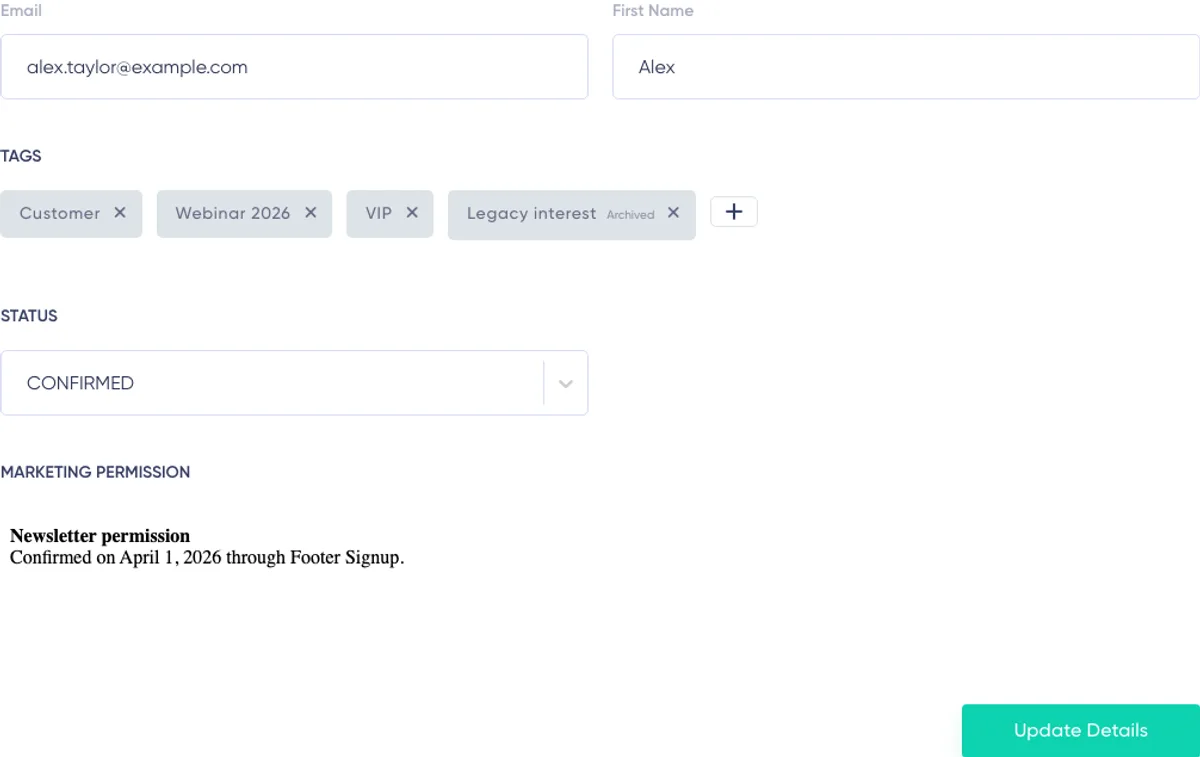
Subscriber Header
The top of the profile shows the subscriber’s email address and Subscription Date.
Maildroppa also requests the Gravatar associated with the email address. If a matching Gravatar is available, it appears beside the profile information.
The email address is the subscriber’s identity in Maildroppa. The current “Update Details” action retains the existing email address. Use the page to update the first name, custom field values, tags, and status without silently moving the activity history to another address.
Editing Subscriber Fields
The profile form contains Maildroppa’s built-in subscriber fields and the custom fields configured under “Settings” → “Subscriber Fields”.
Depending on your field configuration, you can work with:
- Text
- Long Text
- Number
- Date
- Yes/No values
- Single Choice
- Multiple Choice
The field label and allowed input are defined centrally in Subscriber Fields. For example, a Date field uses a date input, a Number field accepts a number, and a Multiple Choice field lets you select several predefined options.
Required active fields must contain a valid value before the profile can be saved.
Built-in Fields
The Email and First Name fields are built-in fields.
First Name can be updated from the profile. The current email address remains the subscriber identity and is kept unchanged by “Update Details”.
Custom Fields
Active custom fields can be updated normally. The stored values can later be used in Segments, send filters, Signup Forms, Automations, and personalized email content.
Use field types consistently. If a field represents a date, number, boolean choice, or controlled list of options, enter a value that matches that field’s configuration.
Archived Fields with Existing Values
An archived field is no longer available for new data entry. However, if the subscriber still has a value in that field, Maildroppa keeps it visible in the profile.
The field is marked “Archived” and is read-only. You can either leave the stored value unchanged or click “Delete value” and then save the profile.
Once an archived value has been removed, you cannot enter a new value unless the field is restored under Subscriber Fields.
Read the Subscriber Fields and Tags guide for all field types, Multiple Choice fields, archiving, restoration, and permanent deletion.
Managing Tags
The Tags section shows the tags currently assigned to the subscriber.
To add or change tags:
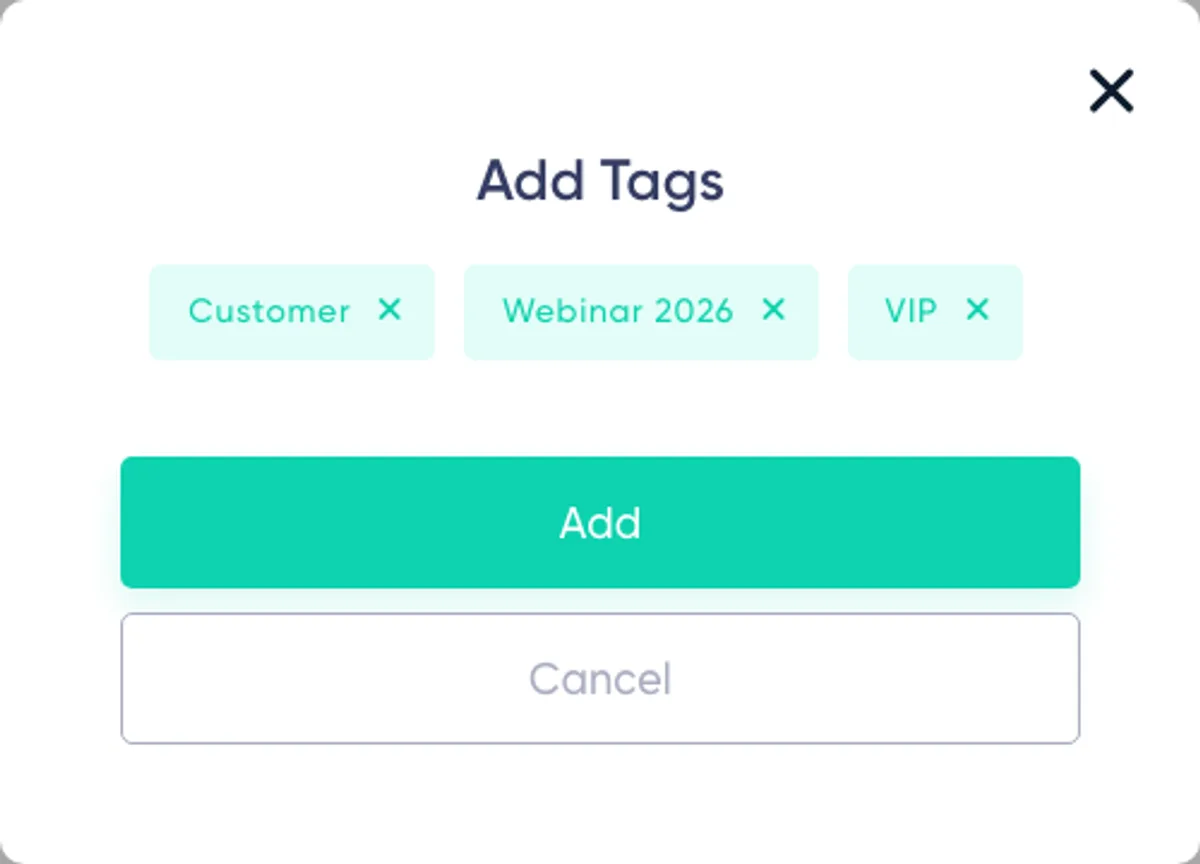
- Click the add-tag control in the Tags section.
- Select the active customer-created tags you want to assign.
- Close or confirm the tag selection dialog.
- Review the complete set of selected tags.
- Click “Update Details” to save the profile.
To remove an assigned tag, click its remove control and then click “Update Details”.
Changing the selection in the form does not update the subscriber until the complete profile is saved.
Archived Tags
If a tag was archived while it was assigned to this subscriber, the tag remains visible and is marked as archived. You can remove the old assignment, but an archived tag cannot be added again from this page.
Restore the tag under Subscriber Fields if it needs to become available for new assignments.
System-managed tags can also be visible on a subscriber. Maildroppa retains those assignments automatically. They cannot be added or removed manually from the profile.
Tags and Automations
Profile changes made on this page can start active “Tag is Added” or “Tag is Removed” Automations. Field changes can likewise start active Field Added, Field Updated, or Field Removed triggers.
Review active Automations before changing a field or tag that controls an important customer journey. Read the Automations guide for trigger behavior.
Changing Subscriber Status
The Status selector controls the subscriber’s current operational status.
The available statuses are:
- Pending
- Confirmed
- Unsubscribed
- Cold
- Bounced
- Soft Bounced
- Blocked
Pending
The subscriber has not completed confirmation and is not currently eligible for ordinary marketing email.
Confirmed
The subscriber is confirmed and can normally receive marketing email.
Set a subscriber to Confirmed only when you have the required permission and any previous suppression reason has been reviewed. Do not use a manual status change to bypass a valid unsubscribe, complaint, or delivery-protection decision.
Unsubscribed
The subscriber opted out or was manually given the Unsubscribed status. Marketing email is stopped.
Cold
The subscriber is inactive because no meaningful engagement was observed for an extended period. Cold subscribers are suppressed from ordinary marketing sending.
Bounced
The address produced a permanent delivery problem, such as a hard bounce or an administrative mailbox failure.
Soft Bounced
Repeated temporary delivery problems reached Maildroppa’s safety threshold. The subscriber remains suppressed while the status is Soft Bounced.
Blocked
A receiving provider blocked the message or the subscriber was stopped manually.
Status changes are important business decisions. They affect current send eligibility, can appear in the Subscriber Timeline, and can affect campaign audiences immediately after the profile is saved.
For more information about automatic protection, read the Deliverability and List Hygiene guide.
Stored Marketing Permission
If Maildroppa has a stored marketing-permission record for the subscriber, the “Marketing Permission” section appears below Status.
This content is a stored consent snapshot and is displayed read-only. It can contain the permission text captured during the signup or confirmation process.
The section is not shown when no agreement snapshot is attached to the current subscriber record. Do not treat the presence or absence of this one display as a complete legal assessment. Your organization remains responsible for its consent records, legal basis, and retention obligations.
Saving Profile Changes
Click “Update Details” after editing fields, tags, or status.
Maildroppa validates the complete profile, saves the changes, refreshes the current subscriber, updates affected campaign audiences, and refreshes the Subscriber Activity data.
Wait for the success message before leaving the page. Unsaved field, tag, or status changes are lost when you navigate away.
If a manual list audit is in progress, the update can be temporarily blocked. In that case, no profile change is applied. Wait for the audit to finish and submit the update again.
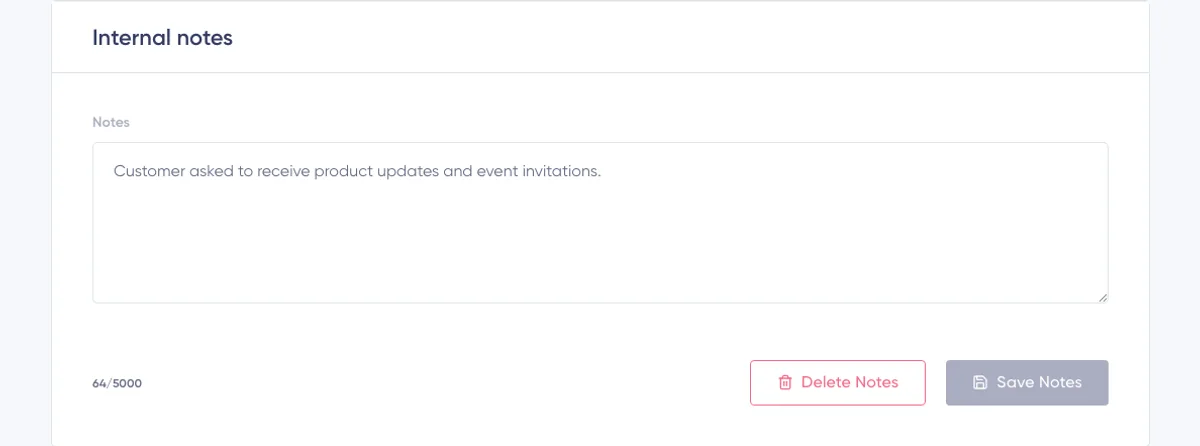
Internal Notes
The “Internal notes” card is located below the profile form.
Use it for account-internal context that helps your team understand or support the subscriber, for example:
- A requested follow-up
- The source of a manual correction
- A customer-service summary
- A reminder to verify information before the next campaign
Notes can contain up to 5,000 characters.
To save a note:
- Enter or edit the text.
- Check the character counter.
- Click “Save notes”.
- Wait for the “Notes saved” message.
To remove the stored note, click “Delete notes”. Saving an empty or whitespace-only note also removes the stored content.
Internal notes are separate from Subscriber Fields. Do not use notes for data that must be segmented, personalized, imported, or collected through a Signup Form. Create a structured Subscriber Field for that purpose.
Store only necessary information and avoid adding secrets or sensitive personal data without a defined business purpose and appropriate access controls.
Understanding the Subscriber Activity Report
The Subscriber Activity report appears below Internal notes. It combines the subscriber’s current state with stored campaign delivery, engagement, consent, and lifecycle signals.
The report is diagnostic. It helps you understand what Maildroppa observed and why the subscriber is currently sendable or suppressed.
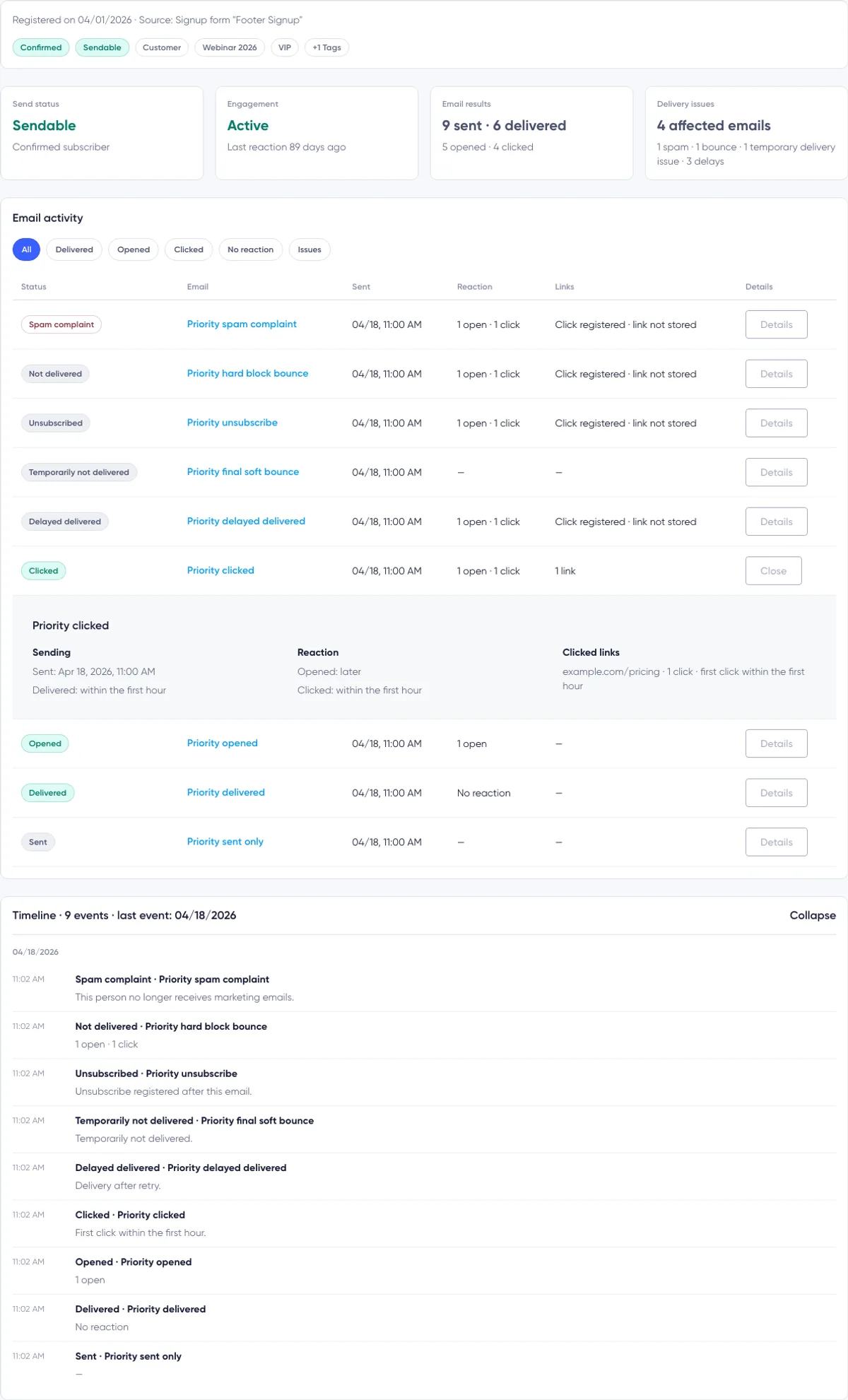
The top of the report contains:
- Registration date and source
- Current subscription status
- Current email send eligibility
- Up to three assigned tags
- A “+ number Tags” indicator when more tags are assigned
- Four summary cards
- A contextual warning or status message when attention is required

Registration Source
The Activity header shows when the subscriber was registered and the stored source of the subscriber.
Possible sources include:
- A named Signup Form
- A named Import
- Added manually
- API
- Unknown source for older records without reliable source evidence
When a Signup Form or import name is available, Maildroppa displays the stored name snapshot. This makes it easier to understand where the relationship started even if the current configuration has changed.
Subscription Status and Send Eligibility Are Different
The Activity header shows two separate pills.
The first pill is the subscriber’s stored status, such as Confirmed, Pending confirmation, Unsubscribed, Cold, Temporarily blocked, Address undeliverable, or Blocked.
The second pill answers the operational question: can Maildroppa currently send marketing email to this person?
It displays either:
- Sendable
- Not sendable, followed by the reason
Reasons can include:
- Not confirmed
- Unsubscribed
- Spam complaint
- Address undeliverable
- Provider blocked
- Stopped manually
“Sendable” does not guarantee that a future email will be delivered. It means that the current subscriber state does not prevent Maildroppa from attempting the send.
The Four Activity Summary Cards
Send Status
The Send Status card repeats the most important current eligibility decision.
For a sendable contact, it shows “Sendable” and “Confirmed subscriber”. For a suppressed contact, it shows “Not sendable” and the relevant reason or date when available.
Engagement
The Engagement card evaluates recent opens and clicks for Confirmed subscribers.
The possible values are:
Active — The latest recorded open or click was within the last 30 days.
Cooling — The latest recorded open or click was more than 30 days ago but no more than 90 days ago.
Cold — At least one email was delivered, but the latest recorded engagement was more than 90 days ago.
Never engaged — At least three emails were delivered, but no open or click was recorded.
Not evaluated — Maildroppa does not yet have sufficient reliable data, no email has been sent, or the subscriber is not currently Confirmed.
Engagement is calculated from the stored campaign signals available at the time the report is loaded. It is not a manually assigned score.
Email Results
The Email Results card shows:
- Number of campaign emails sent
- Number of campaign emails considered delivered
- Number of campaign emails with at least one open
- Number of campaign emails with at least one click
These are email counts, not raw event counts. One campaign email opened five times counts as one Opened email in the summary. The corresponding row can still show all five recorded open events.
An open or click is also evidence that the email reached the recipient. Therefore, the Delivered count can include an email with an open or click signal even if a separate delivery event was not retained.
Delivery Issues
The Delivery Issues card shows how many campaign emails were affected by a stored delivery problem.
Problems include:
- Spam complaints
- Hard, administrative, or block bounces
- A final temporary bounce without a later delivery or engagement signal
- Delivery delays, including messages that were delivered after a delay
The card counts affected emails. Several issue events for one campaign email still represent one affected email. When several issue types exist, the detail line shows a breakdown.
If no issue was found, the card displays “None” and explains that no bounces or spam complaints were observed.
Contextual Warnings and Shortcuts
Maildroppa displays a banner when the current activity needs attention.
Examples include:
- A spam complaint stopped future marketing email
- Sending was stopped because of a bounce
- The subscriber unsubscribed
- Several temporary delivery issues were observed
For a bounce, complaint, or temporary delivery issue, the banner can include “Show affected email” or “Show affected emails”. Clicking it selects the Issues filter in Email activity.
Email Activity Filters
The Email activity section lists campaign emails associated with this subscriber.
Use the filter buttons to focus on a particular result:
All
Shows every stored campaign email activity row.
Delivered
Shows emails with a delivery, open, or click signal.
Opened
Shows emails with at least one recorded open.
Clicked
Shows emails with at least one recorded link click.
No reaction
Shows emails that reached the subscriber but have no recorded open or click.
Issues
Shows emails with a complaint, hard or block bounce, undelivered final soft bounce, or delivery delay.
The number on each filter is the number of matching campaign emails, not the number of individual events. A filter is disabled when its count is zero.
Click the currently selected filter again to return to All. If there are more matching rows than initially loaded, click “Load more”.
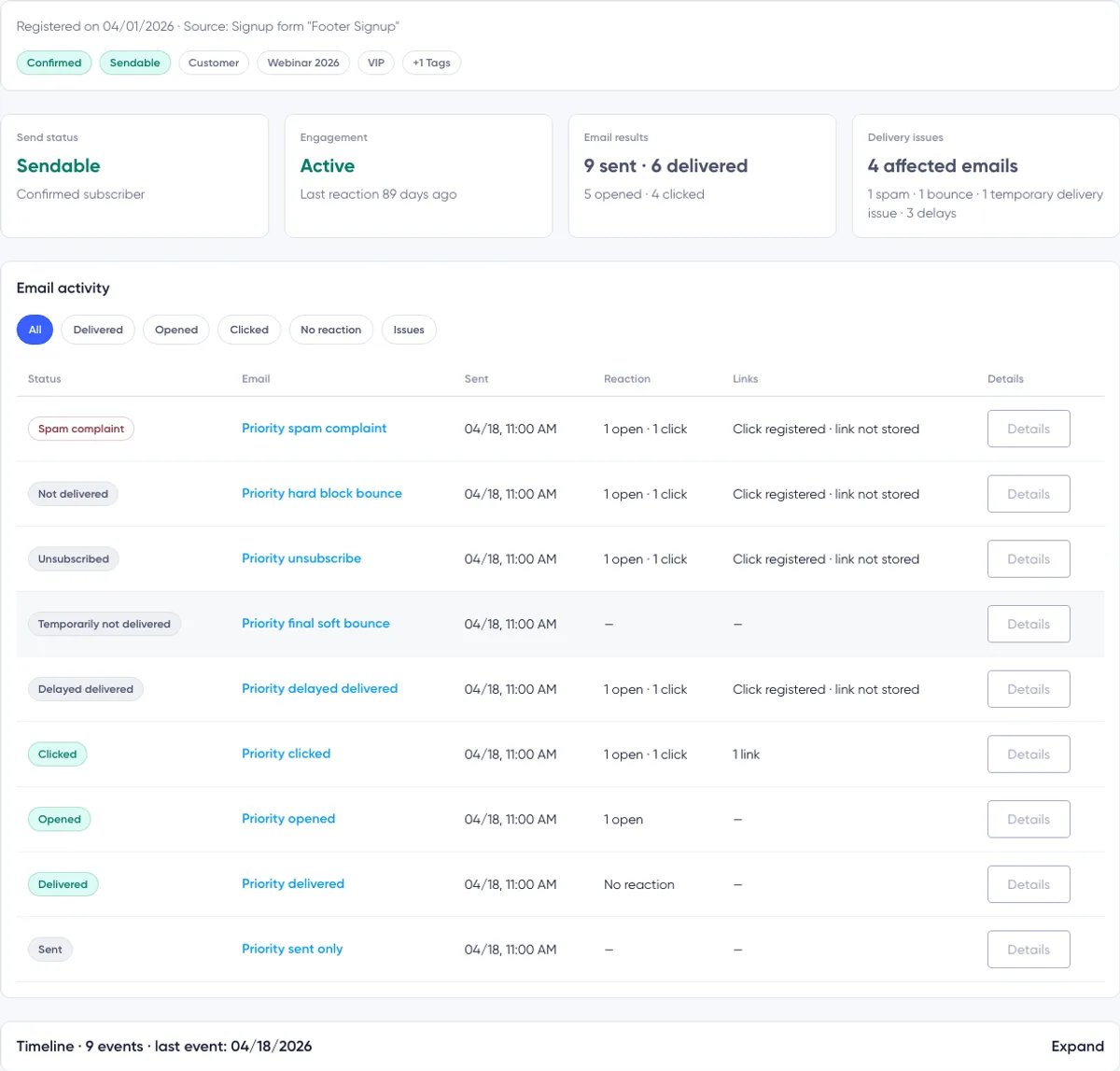
Reading an Email Activity Row
On desktop, each row contains:
- Status
- Email subject
- Sent date and time
- Reaction
- Links
- Details
On smaller screens, Maildroppa presents the same information as responsive cards.
Status
The status summarizes the strongest currently stored result for that campaign email.
Possible row labels include:
- Spam complaint
- Not delivered
- Unsubscribed
- Temporarily not delivered
- Delivery delayed
- Delayed delivered
- Clicked
- Opened
- Delivered
- Sent
When several signals exist, the safety-relevant outcome takes priority. For example, a complaint remains the row status even if an earlier open was also recorded. Open and click counts remain available in Reaction and Details.
Email Subject
Click the subject to open that campaign’s report at its Activity section.
If the campaign has no subject, Maildroppa displays “No subject”.
Sent
The Sent column shows the campaign transmission time when available. If no separate transmission timestamp is stored, Maildroppa uses the time of the recorded campaign activity.
Reaction
Reaction shows the number of recorded opens and clicks for this campaign email.
If delivery was recorded but no open or click exists, it shows “No reaction”. A dash means that no useful reaction or delivery result is available.
Links
The Links column summarizes clicked links.
It can show:
- No click information
- One link
- Several clicks across one or more links
- “Click registered · link not stored” when a click event exists but the destination URL was not retained
Details
Click “Details” to expand the row. Click “Close” to collapse it again.

Expanded Email Details
The expanded area has three blocks.
Sending
This block shows:
- The full sent timestamp
- Whether and when delivery was recorded
- Whether delivery was delayed
- Whether the final result was not delivered, delivered after delay, unsubscribed, or a complaint
Time-to-delivery is summarized as within the first hour, the same day, or later.
Reaction
This block shows when the first open and the latest stored click occurred relative to sending or delivery.
If no open or click was recorded, it displays “No reaction”.
Clicked Links
For every stored clicked URL, this block can show:
- The destination URL
- Number of clicks
- Time of the first recorded click
Other links in the email are not listed unless a click was recorded for them.
Provider and Delivery Details
For supported complaint, bounce, final soft-bounce, or delay records, the expanded row can show one of these buttons:
- “Show provider response”
- “Show delivery details”
The button appears only when Maildroppa can link the subscriber’s campaign email to stored provider events.
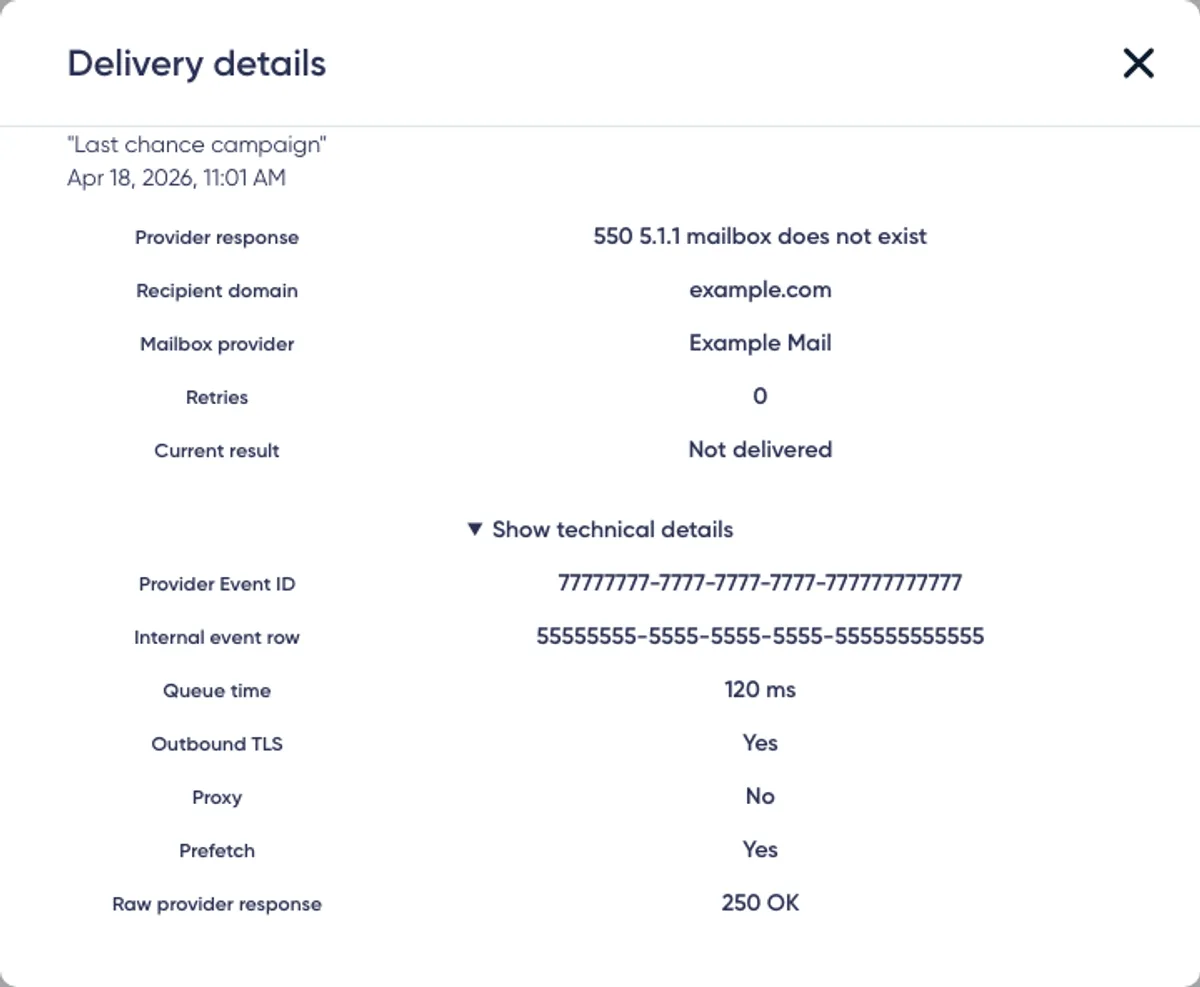
The Delivery details dialog can show:
- Provider response
- Recipient domain
- Mailbox provider
- Number of retries
- Current result
- Timestamp of the relevant event
Open “Show technical details” for additional diagnostic data:
- Provider Event ID
- Internal event row
- Queue time
- Outbound TLS indicator
- Proxy indicator
- Prefetch indicator
- Sanitized raw provider-response preview
Maildroppa removes or masks sensitive values such as addresses and IP information from provider-response previews.
Some fields can display “Not stored”. This is normal when the sending provider did not supply a value, the event predates the available retention, or the campaign email could not be linked to a retained provider event.
The main delivery outcomes have different meanings:
Delivery delayed — The provider had not accepted the email yet. A later retry can still succeed.
Temporary delivery problem — A soft condition such as a full mailbox or timeout prevented delivery at that time.
Not delivered — A hard or administrative condition indicates that the address could not receive the email.
Provider blocked — The receiving system rejected the message or sender for a blocking or policy reason.
Spam complaint — The recipient reported the message. The subscriber is no longer sendable for marketing email.
Provider details are diagnostic evidence, not an instruction to reactivate a subscriber. Resolve the underlying consent or delivery issue before changing Status.
Understanding the Timeline
The Timeline is collapsed by default. Its header shows the total number of stored events and the date of the latest event when available.
Click the Timeline header to expand it. Events are grouped by date and show their time, title, and an explanation when available.
The Timeline can include:
- Campaign delivery and engagement activity
- Subscriber creation
- Confirmation and consent records
- Status changes
- Unsubscribe events
- Spam complaints
- Hard, soft, administrative, and block bounces
- Delivery-check decisions
- Cold classification because of missing engagement
- Manual blocking
Problem campaign events in the Timeline can also provide the same provider-details button as their Email activity row.
Click “Load more” when older events are available.
The Timeline is not a general audit log for every profile edit. Changes to ordinary fields, tags, and internal notes are not necessarily listed. Status, consent, campaign, and delivery lifecycle events are its primary purpose.
How to Interpret Opens and Clicks
Open and click data are useful engagement signals, but they are not perfect proof of human behavior.
An open usually depends on an image-tracking request. Privacy protection, image blocking, security scanning, proxy servers, and prefetching can hide or create signals.
A click is usually stronger evidence of interaction, but automated security tools can also inspect links. Provider technical details can sometimes identify proxy or prefetch behavior, but those indicators are not available for every event.
Use activity data to understand patterns rather than treating one isolated open or click as absolute proof.
Historical Data and Report Limitations
The report can only display information that was stored and can still be associated with this subscriber.
Keep these limitations in mind:
- Older campaign activity may not contain every modern detail.
- Provider response data is available only for supported and retained events.
- A click can be stored even when its destination URL is unavailable.
- The subject shown in Email activity comes from the current campaign variant. It is not guaranteed to be an immutable copy of the exact subject at send time.
- Consent entries in the Timeline are summaries and are not a complete legal consent export.
- “Not evaluated” does not mean that the subscriber is inactive; it means that the current data is insufficient for an engagement classification.
- No stored open or click does not prove that the email was never read.
The campaign report provides campaign-wide results. Subscriber Details provides the history and current diagnosis for one person.
Recommended Investigation Workflow
Use this process when a subscriber asks about an email or when you investigate a delivery issue:
- Confirm that you opened the correct subscriber email address.
- Check the stored Status and the separate Sendability pill.
- Read any warning banner before changing profile data.
- Review the four summary cards for context.
- Select Delivered, Opened, Clicked, No reaction, or Issues as required.
- Find the relevant campaign by subject and sent date.
- Expand Details and review Sending, Reaction, and Clicked Links.
- Open provider details when the button is available.
- Expand the Timeline to understand later status or consent changes.
- Add a short internal note if your team needs to remember the conclusion.
Do not manually confirm a suppressed subscriber merely to retry a campaign. Resolve the underlying permission, address, or provider issue first.
Troubleshooting
My Profile Changes Were Not Saved
Click “Update Details” after changing fields, tags, or Status and wait for the success message. Selecting tags or editing a field does not save the profile automatically.
If a manual list audit is in progress, the update remains blocked until the audit is complete.
The Email Address Did Not Change
The current “Update Details” workflow deliberately retains the subscriber’s existing email identity. It saves First Name, custom field values, tags, and Status without changing the email address.
I Cannot Edit an Archived Field
Archived fields with existing values are read-only. Leave the value unchanged, use “Delete value”, or restore the field under Subscriber Fields before collecting a new value.
I Cannot Add a Particular Tag
Only active customer-created tags can be assigned manually. An archived tag can remain visible when already assigned, but it cannot be newly selected. Restore it first if it should return to active use. System-managed tags are retained automatically and cannot be changed from this form.
Activity Data Is Not Available
Profile details remain editable even when Subscriber Activity cannot be loaded. Reload the page later. If only an additional page failed, use “Try again” below the activity list.
An Activity Filter Is Disabled
Its count is zero. Maildroppa has no campaign email matching that outcome in the available activity data.
No Email Activity Is Listed
If no campaign has reached this person, the page displays “No email sent yet”. Delivery, opens, and clicks appear after corresponding campaign signals are stored.
Show Delivery Details Is Missing
Provider details require a supported campaign email with a retained provider link. The button is not shown for ordinary delivered, opened, or clicked rows and can also be unavailable for older or incompletely linked events.
Delivery Details Says That Data Is Unavailable
Maildroppa found the campaign email but no matching provider-problem details were retained. Use the visible campaign status, summary, and Timeline; the missing technical data cannot be reconstructed from the profile page.
A Click Is Listed Without a URL
The click event was stored, but its destination URL was not retained. The report shows “Click registered · link not stored” instead of guessing the destination.
The Campaign Subject Looks Different from the Sent Email
Email activity currently displays the subject from the current campaign variant. If that variant was renamed or edited later, the displayed subject can differ from the exact historical subject.
Engagement Is Not Evaluated
The subscriber may not be Confirmed, no email may have been sent, or Maildroppa may not yet have enough delivered and engagement data for a reliable classification.
Notes Could Not Be Loaded
Click “Retry” in the Internal notes card. Notes are stored separately, so a notes error does not prevent profile editing or Subscriber Activity from loading.
Ready to Send Better Emails?
Stop juggling bloated tools or overpriced plans. Maildroppa offers personal support, privacy-conscious controls, and powerful email marketing - starting free forever.
No credit card required. No time limit.