Contents
the email tool that makes email marketing simple


Import Subscribers From a File
Published: · Last updated: · By Marcus Biel
In brief
Learn how to quickly and easily import your subscriber list in .csv format to Maildroppa, map .csv columns to custom subscriber fields.
Maildroppa lets you import subscribers from CSV and Excel files (.xls, .xlsx) — whether you're switching from another email marketing platform, restoring from a backup, or adding subscribers you collected outside the app.
Import from CSV or Excel
By default, Maildroppa supports the following subscriber fields:
- First Name — optional
- Email — required
Any additional custom subscriber fields or tags — such as Last Name, Birthdate, Favorite Colors, or a special offer tag — must be created in the Maildroppa App before you start importing.
Maildroppa supports imports from CSV files and Excel files (.xls and .xlsx).
Tip: Use an export as your template
The fastest way to see how your import file should look is to create the fields you want to use in Maildroppa, add one sample subscriber filled in with realistic values, and then export your subscribers. The resulting file is a ready-made template — it shows you the column names, value formatting, and, for multi-select fields, how to combine multiple values inside one cell. You can then use that structure for your real import.
To import a file, first click on the Subscriber tab.

On the Subscriber page, click "Add a New Subscriber" on the right side, below the (probably still empty) Subscriber Report. From the menu that appears, choose "Import from CSV".
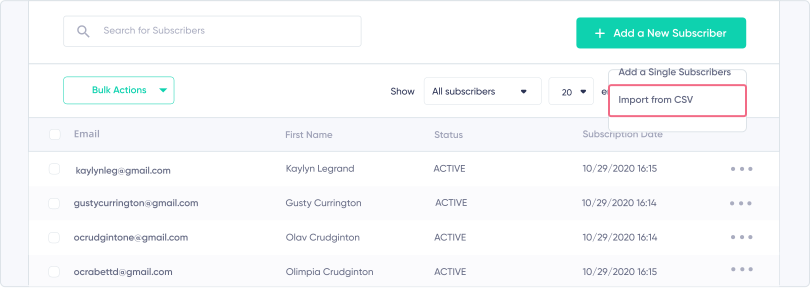
Note: Even though the menu item is called "Import from CSV", you can also upload supported Excel files (
.xls,.xlsx) through it.
Select the File
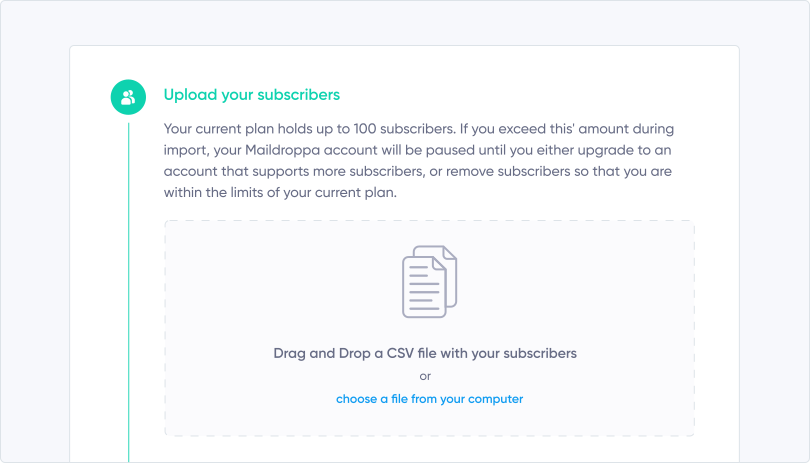
On the next page, drag and drop your CSV or Excel file, or select it from your computer.
Settings
Under Settings, you can determine whether the first line of your file contains field and tag names.
You can also specify the status of the subscribers you want to import:
- Confirmed
- Unsubscribed
- Blocked
For CSV files, you also need to specify the delimiter that separates the columns. Maildroppa supports the following delimiters:
- Comma — the default, used by most exports
- Semicolon — common in files created with Microsoft Excel in German-speaking regions
- Tab — used in TSV (tab-separated values) files
- Space
If you do not know which delimiter your file uses, leave the setting unchanged. In most cases, the default (comma) works.
For Excel files (.xls, .xlsx), Maildroppa reads the spreadsheet structure directly, so no delimiter setting is required.
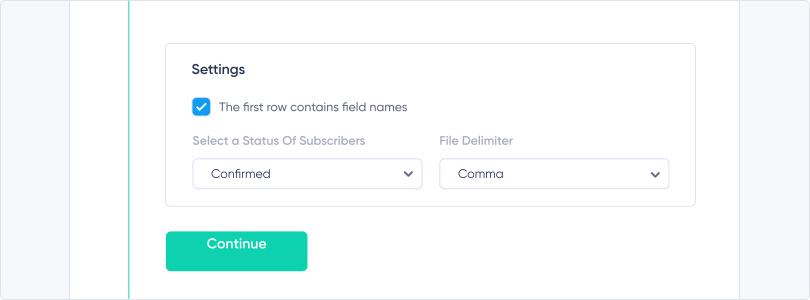
Once you're done, click the Continue button.
Mapping Columns to Custom Subscriber Fields and Tags
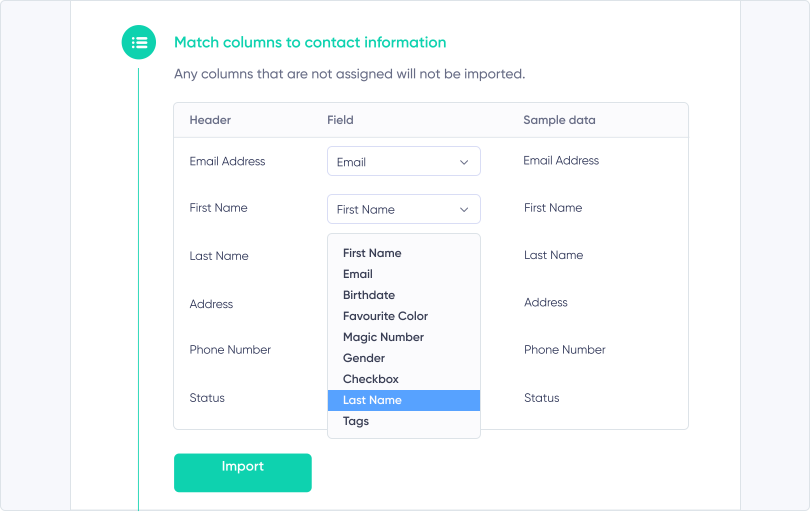
Now you will see a preview of your data. If your file has a header in the first row, you will see the column headings listed on the far left. The next column allows you to match each column in your file to a Maildroppa field or tag.
For example, you can map:
emailto Emailfirst_nameto First Namefavorite_colorsto your Favorite Colors multi-select fieldspecial_offerto a tag
On the far right, under "Sample Data", you will see the content of the first row of data, to make it easier to assign each column to the correct field.
When you have assigned all fields, click Import.
File Processing
The import of your subscribers will now take place. Incorrect records will be skipped, and existing subscribers will be updated.

We will send you an email when the import of your file is complete.

Importing Multi-Select Field Values
A multi-select field can hold several selected options for the same subscriber — for example a Favorite Colors field where one subscriber has blue, yellow, and red selected at the same time. Other typical use cases are interests, product categories, or preferences.
Before importing, create the multi-select field in Maildroppa and define all allowed options there.
In your file, use one column for the multi-select field. If a subscriber should have multiple selected values, put all values into the same cell and separate them with a pipe character |:
| favorite_colors | |
|---|---|
| anna@example.com | blue|yellow|red |
| ben@example.com | green|blue |
| clara@example.com | yellow |
In a CSV file, the same data looks like this:
email,favorite_colors
anna@example.com,blue|yellow|red
ben@example.com,green|blue
clara@example.com,yellow
A few rules to keep multi-select imports clean:
- Values must match the existing active option labels defined in Maildroppa exactly (case-sensitive).
- Avoid extra spaces around the pipe character. Use
blue|yellow|red, notblue | yellow | red. - Use the pipe
|to separate multiple selected values inside one cell. Do not use the file delimiter (comma, semicolon, tab, or space) for this — those are reserved for separating columns across the whole file. - Make sure every value already exists as an option in the multi-select field before importing.
Heads up: unknown values skip the whole row
The import preview helps you map columns to Maildroppa fields, but it does not validate every row before the import starts.
If a row contains a multi-select value that does not match an existing active option label, the entire row is treated as incorrect and skipped during import — not just that single value. Maildroppa does not partially import the matching values, does not import or update the subscriber without the multi-select field, and does not automatically create unknown options.
The completion email confirms that the import has finished, but it does not list skipped rows or row-level error reasons. This is why the export-as-template trick from the top of this guide is especially useful: it helps make sure your values match the option labels exactly.
Ready to Send Better Emails?
Stop juggling bloated tools or overpriced plans. Maildroppa offers personal support, privacy-conscious controls, and powerful email marketing - starting free forever.
No credit card required. No time limit.